
Eleuthero
Eleutherococcus senticosus
A thorny shrub of the ginseng family, distinct from Panax, long used in Siberian and north-east Asian practice.
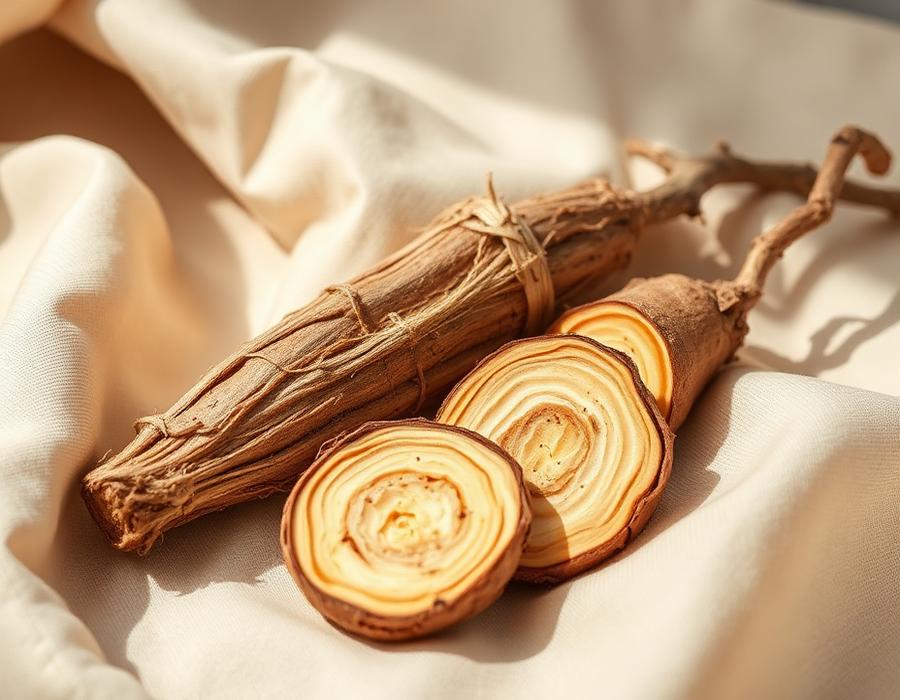
- Common name
- Eleuthero
- Scientific name
- Eleutherococcus senticosus
- Family
- Araliaceae
- Plant part
- Root and rhizome
- Native region
- Eastern Siberia, north-eastern China, Korea, Japan
- Traditional systems
- Traditional Chinese Medicine
Botanical classification
A deciduous spiny shrub of the Araliaceae. Despite the older name Siberian ginseng, it is a different genus from Panax.
Origin & traditional use
Documented in Chinese materia medica and later widely studied in the Soviet Union as a tonic for those working in demanding conditions.
Modern scientific perspective
Eleutherosides are the constituents of interest. A World Health Organization monograph summarises traditional use, constituents and safety.
Evidence snapshot
Traditional record clear. Constituents defined. Human evidence limited and older.
Proposed mechanisms
Adaptogenic pathways are the usual framing in the literature.
- Adaptogenic activityStudied for a non-specific influence on the body's response to everyday stressors.
Key active constituents
- Eleutheroside B
- Eleutheroside E
- Polysaccharides
Safety & considerations
Generally well tolerated in traditional amounts.
- Contraindications
- Uncontrolled hypertension warrants professional guidance.
- Drug interactions
- Consider guidance alongside anticoagulant medication.
- Pregnancy
- Not recommended.
- Breastfeeding
- Not recommended.
- Cardiovascular considerations. If you are managing blood pressure or cardiovascular conditions, seek professional guidance before use.
References
- 01 Eleutherococcus senticosus monograph. World Health Organization, WHO Monographs on Selected Medicinal Plants, 2004 — Government Resource
- 02 Adaptogens: a review of the concept and its evidentiary basis. Various, Pharmaceuticals, 2018 — Systematic Review
Related botanicals
These statements have not been evaluated by the Food and Drug Administration. This product is not intended to diagnose, treat, cure, or prevent any disease.