
White Ginseng
Panax ginseng C.A. Meyer
White Ginseng is the mature root gently cleaned and naturally dried, preserving its original botanical character without the steaming process used for Red Ginseng.
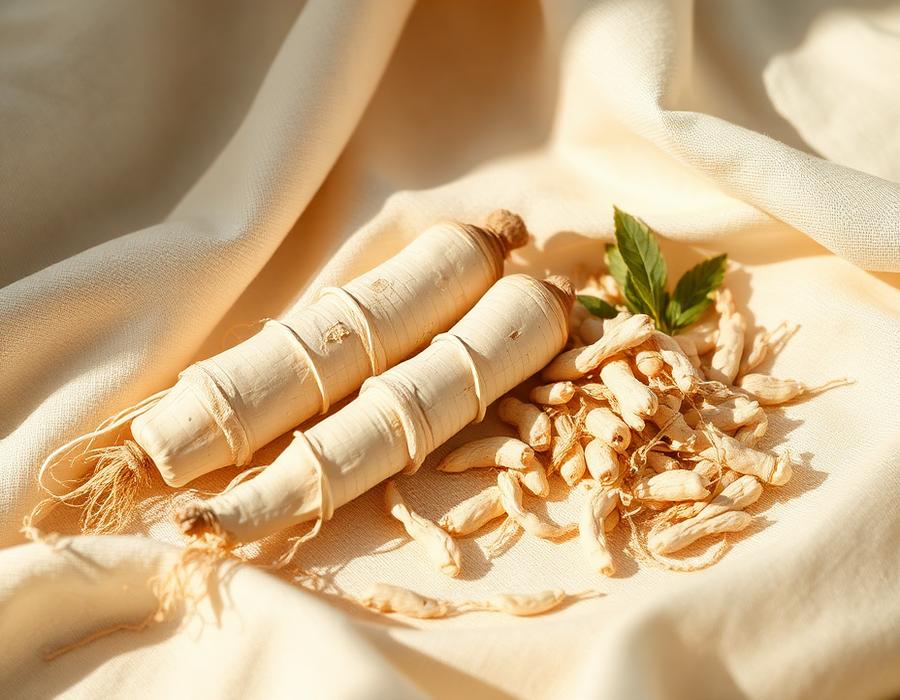
- Common name
- White Ginseng
- Scientific name
- Panax ginseng C.A. Meyer
- Family
- Araliaceae
- Plant part
- Root
- Native region
- Korea, north-eastern China, eastern Russia
- Traditional systems
- Traditional Chinese Medicine
Botanical classification
Family Araliaceae · Genus Panax · Species Panax ginseng · Plant part: root · Preparation: naturally dried mature root.
Origin & traditional use
A history extending more than 2,000 years across Korea and China, traditionally prepared as teas, decoctions, powders and formulations. The root is air-dried after harvest, preserving a naturally distinct phytochemical profile.
Modern scientific perspective
Widely studied for ginsenosides and other phytochemicals through laboratory, animal and human research. Why we selected it: the traditional drying preparation yields a naturally distinct composition that complements Red Ginseng and the other botanicals, reflecting our belief in synergy over reliance on a single ingredient. Quality philosophy: mature, air-dried roots with verified identity and purity. Akasha perspective: the same species, a different hand — proof that preparation is part of the botanical.
Evidence snapshot
Traditional use: more than 2,000 years in TCM and Korean traditions. Preclinical research: substantial work on phytochemistry. Human research: studies with varying findings. Scientific consensus: Panax ginseng remains one of the most extensively researched botanical species.
Proposed mechanisms
Ginsenosides, polysaccharides and polyacetylenes are the constituent classes most frequently examined.
Key active constituents
- Ginsenosides
- Polysaccharides
- Polyacetylenes
- Polyphenols
- Essential amino acids
- Natural antioxidants
- Trace minerals
Safety & considerations
Widely consumed as a food and botanical for generations. Discontinue use if unexpected sensitivity occurs. These statements have not been evaluated by the Food and Drug Administration. This product is not intended to diagnose, treat, cure, or prevent any disease.
- Contraindications
- Consult a healthcare professional if managing a medical condition.
- Drug interactions
- Consult a healthcare professional if taking prescription medications.
- Pregnancy
- Consult a healthcare professional before use if pregnant.
- Breastfeeding
- Consult a healthcare professional before use if nursing.
- Pregnancy and nursing. Not intended for use during pregnancy or while nursing. Speak with your healthcare provider.
- Medication interaction. If you take prescription medication, speak with your healthcare provider before use.
References
- 01 Ginsenosides: chemistry, biosynthesis, analysis, and potential health effects. Christensen LP, Advances in Food and Nutrition Research, 2009 — ReviewSource
- 02 Asian Ginseng. National Center for Complementary and Integrative Health, NCCIH, 2020 — GuidanceSource
- 03 WHO Monographs on Selected Medicinal Plants — Radix Ginseng. World Health Organization, WHO Monographs, 1999 — MonographSource
Related journal articles
- When Intimacy Feels Different: supporting a partner through erectile difficultyOccasional erectile difficulty is common. A calm, compassionate look at pressure, presence, and how couples can stay connected when the body responds differently.
- Semen Retention & Sexual Energy: ancient wisdom for modern menTaoist, yogic and Ayurvedic traditions treated sexual energy as something to cultivate. A grounded look at retention, transmutation, and what the practice actually asks of you.
- Understanding the G-Zone: a guide to arousal, pleasure & deeper intimacyThe G-zone is not a hidden button. It is part of a larger network of arousal, anatomy, and presence. A grounded, educational guide to exploring pleasure with curiosity instead of pressure.
- We've Stopped Having Sex: Why Desire Changes—and How to Find Your Way BackWhen intimacy fades, it doesn't mean love is gone. A grounded look at why desire changes, how to talk about it without blame, and practical ways to find your way back.
- The Female Arousal Response: What Happens When the Body AwakensFemale arousal isn't a simple switch. A grounded look at what actually happens in the body—blood flow, erectile tissue, the nervous system, and why patience matters.
- The 20-Minute Ritual: Why Slowing Down Can Transform IntimacyBetter intimacy often comes from slowing down, not doing more. A simple twenty-minute ritual for presence, anticipation, and deeper connection.
- When the Body Doesn't Cooperate: Understanding Erectile Difficulty Without the ShameIt happens. You want sex. You're attracted to your partner. Everything seems like it should be working—and suddenly your body doesn't cooperate. For many men, that moment feels much bigger than it actually is. But an erection is not a measure of manhood, and one difficult night does not automatically mean you have erectile dysfunction.
- Ancient Chinese Wisdom for Sexual Vitality: Jing, Qi & the Art of Cultivating EnergyWhat if sexual wellness wasn't viewed as something separate from the rest of your health? For thousands of years, traditional Chinese philosophy has approached vitality through a broader lens—energy, rest, movement, food, emotion, sexuality, age, and the changing rhythms of the body. At the center of these teachings are Jing and Qi, two concepts that offer a fascinating glimpse into an ancient philosophy of cultivation.
- Music, Desire & Intimacy: How Sound Changes the Energy of a RoomSound shapes atmosphere before anyone touches. How music, rhythm, and ritual can shift the emotional energy of a room — and deepen intimacy.
- The Bedroom as Sacred Space: Ritual, Play & Spiritual ConnectionSacred does not have to mean serious. How ritual, touch, breath, and play can turn an ordinary bedroom into a space made for presence.
- Sexual Energy & Manifestation: The Ancient Art of Creative IntentionCan desire be directed toward intention? A ritual approach to sexual energy, creative attention, transmutation, and the ancient art of bringing what you want into action.
- The Brain Is Your Most Powerful Sexual Organ: Desire, Dopamine & the Psychology of ArousalUnderstanding why desire begins in the mind — and how attention, anticipation, novelty, and emotional connection help shape the body's experience of arousal.
- Sacred Sexuality for Couples: How to Create Deeper Emotional & Energetic ConnectionA guide to slowing down, creating shared ritual, and building deeper emotional and energetic connection through presence and attention.
- When Sex Gets Too Routine: How to Bring Back Curiosity Without the Pressure to PerformPractical exercises for couples to disrupt predictable intimacy, redistribute the responsibility for desire, and rediscover curiosity without performance pressure.
- The Art of Erotic Exploration: Trust, Curiosity & Trying Something New TogetherA gentle guide to exploring intimacy together: trust, curiosity, communication, and the freedom to say yes, maybe, or not tonight.
- Beyond the Basics: How Lubricants Can Add Comfort, Play & Pleasure to IntimacyLubricant doesn't have to solve a problem. It can simply make touch feel smoother, more comfortable, and more playful—whether you're exploring alone or with a partner.
- The Clitoris, the Vagina & the Truth About Female OrgasmFor generations, women were given a surprisingly incomplete map of their own pleasure. Modern anatomy tells a more interesting story—one that invites curiosity, communication, and presence.
- Beyond One Kind of Orgasm: Understanding the Different Ways Men & Women Experience PleasureOrgasm isn't a single event. From clitoral and G-zone to prostate and full-body experiences, explore the remarkable range of human pleasure—without turning intimacy into a performance.
These statements have not been evaluated by the Food and Drug Administration. This product is not intended to diagnose, treat, cure, or prevent any disease.