
Zeolite (Clinoptilolite)
Clinoptilolite
A crystalline aluminosilicate formed where volcanic ash meets seawater, whose honeycomb lattice carries a natural negative charge.
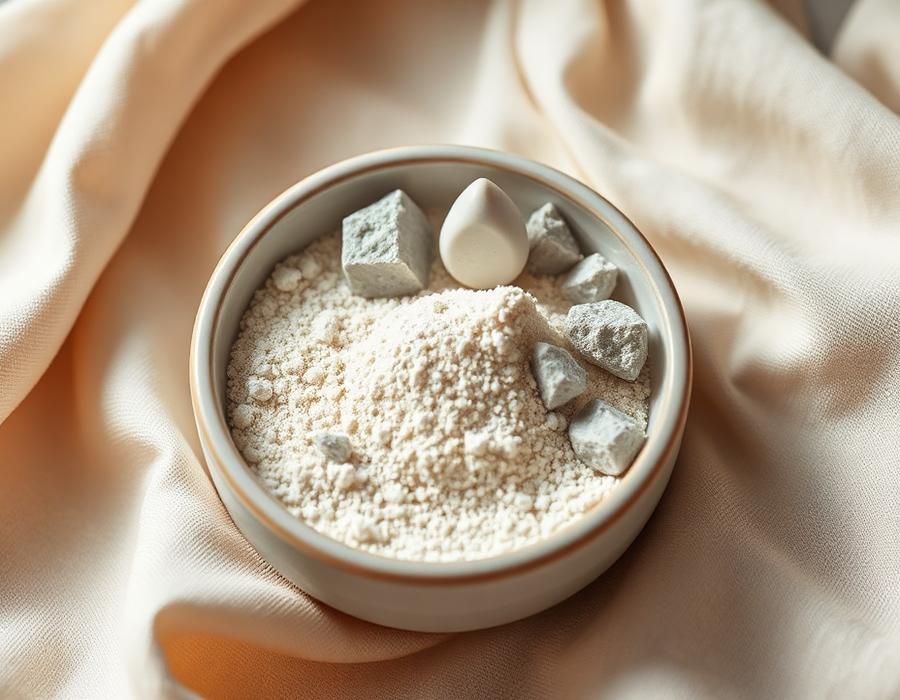
- Common name
- Zeolite (Clinoptilolite)
- Scientific name
- Clinoptilolite
- Family
- Mineral — tectosilicate
- Plant part
- Crystalline mineral
- Native region
- Volcanic sedimentary deposits worldwide
Botanical classification
Not a plant. Clinoptilolite is a naturally occurring zeolite of the heulandite group, classified among the tectosilicate minerals.
Origin & traditional use
Zeolite deposits have been quarried since antiquity for construction and water clarification. Its use in nutrition is comparatively modern.
Modern scientific perspective
The material is extensively described in materials science for its cation-exchange capacity and molecular sieving behaviour. Nutritional research is more recent and smaller in volume.
Evidence snapshot
Physical properties exhaustively characterised in materials science. Nutritional literature limited and largely preclinical.
Proposed mechanisms
The negatively charged crystalline lattice exchanges cations, a physical rather than pharmacological property.
- Cation exchangeA physical property of certain crystalline minerals with a negatively charged lattice.
Key active constituents
- Aluminosilicate lattice
- Exchangeable calcium, potassium and sodium cations
Safety & considerations
Use only material of documented purity, tested for heavy metals by an independent laboratory.
- Contraindications
- Insufficient data for those with kidney conditions.
- Drug interactions
- May bind concurrently taken oral medication; separate doses by several hours.
- Pregnancy
- Avoid.
- Breastfeeding
- Avoid.
- Medication interaction. If you take prescription medication, speak with your healthcare provider before use.
- Adults only. Formulated for adults. Keep out of reach of children.
References
- 01 Clinoptilolite: structure, cation exchange and applications. Various, Molecules, 2019 — Mechanistic Study
Related botanicals
Related journal articles
These statements have not been evaluated by the Food and Drug Administration. This product is not intended to diagnose, treat, cure, or prevent any disease.