
Black Pepper
Piper nigrum L.
Known as the King of Spices and native to the Malabar Coast, black pepper contains piperine, a naturally occurring alkaloid studied for its influence on the absorption of certain nutrients and botanical compounds.
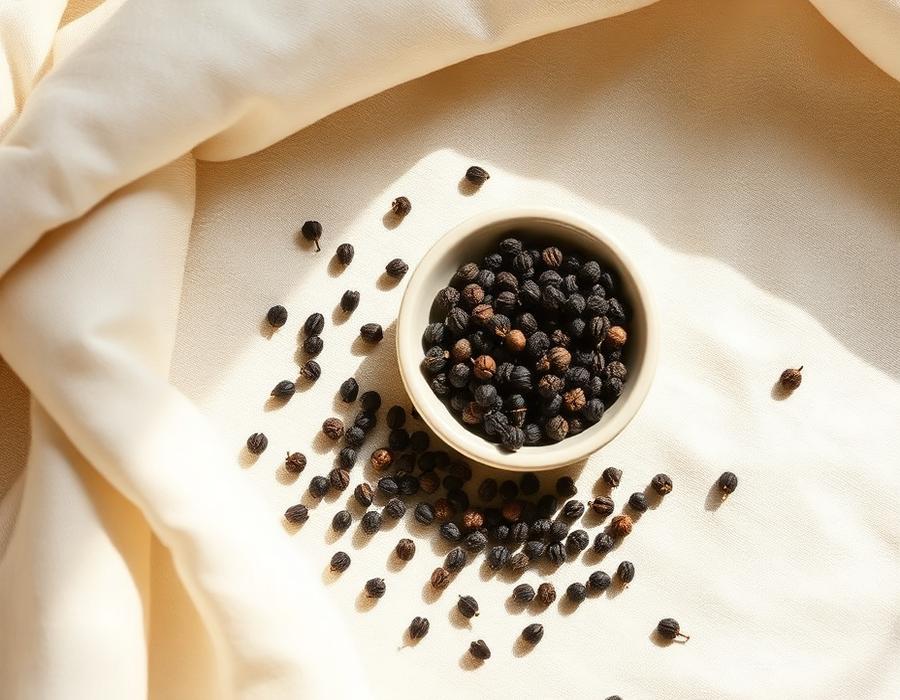
- Common name
- Black Pepper
- Scientific name
- Piper nigrum L.
- Family
- Piperaceae
- Plant part
- Fruit (peppercorn)
- Native region
- South-western India (Malabar Coast)
- Traditional systems
- Ayurveda, Traditional Chinese Medicine
Botanical classification
Family Piperaceae · Genus Piper · Species Piper nigrum · Plant part: fruit, peppercorn · Preparation: standardised fruit extract.
Origin & traditional use
Cultivated for thousands of years and one of the world's earliest internationally traded botanicals, incorporated into Ayurvedic and other traditional preparations as well as culinary traditions worldwide.
Modern scientific perspective
Piperine is researched for its interaction with nutrient transport and metabolic processes. The fruit is also studied for essential oils, flavonoids and antioxidants. Why we selected it: a long history within traditional botanical systems, and piperine represents an important area of scientific interest for botanical formulation. Quality philosophy: standardised fruit extract with verified piperine content and purity testing. Akasha perspective: the companion botanical — present so the rest of the formula is better received.
Evidence snapshot
Traditional use: more than 2,000 years in Ayurvedic, Chinese and Southeast Asian traditions. Preclinical research: extensive work on piperine. Human research: studies on nutrient absorption. Scientific consensus: one of the most extensively studied culinary botanicals.
Proposed mechanisms
Piperine is the constituent most frequently examined, particularly in relation to the absorption of other compounds.
Key active constituents
- Piperine
- Essential oils
- Flavonoids
- Lignans
- Volatile aromatic compounds
- Phenolic compounds
- Natural antioxidants
Safety & considerations
Safely consumed as a culinary spice and botanical for generations. Piperine may influence the absorption of certain medications and nutrients. Discontinue use if unexpected sensitivity occurs. These statements have not been evaluated by the Food and Drug Administration. This product is not intended to diagnose, treat, cure, or prevent any disease.
- Contraindications
- Consult a healthcare professional if managing a medical condition.
- Drug interactions
- Consult a healthcare provider if you take prescription medications, as piperine may influence their absorption.
- Pregnancy
- Consult a healthcare professional before use if pregnant.
- Breastfeeding
- Consult a healthcare professional before use if nursing.
- Pregnancy and nursing. Not intended for use during pregnancy or while nursing. Speak with your healthcare provider.
- Medication interaction. If you take prescription medication, speak with your healthcare provider before use.
References
- 01 Using Dietary Supplements Wisely. National Center for Complementary and Integrative Health, NCCIH, 2024 — GuidanceSource
- 02 Black pepper and its pungent principle-piperine: a review of diverse physiological effects. Srinivasan K, Critical Reviews in Food Science and Nutrition, 2007 — ReviewSource
Related journal articles
- Understanding the G-Zone: a guide to arousal, pleasure & deeper intimacyThe G-zone is not a hidden button. It is part of a larger network of arousal, anatomy, and presence. A grounded, educational guide to exploring pleasure with curiosity instead of pressure.
- The Female Arousal Response: What Happens When the Body AwakensFemale arousal isn't a simple switch. A grounded look at what actually happens in the body—blood flow, erectile tissue, the nervous system, and why patience matters.
- Ancient Chinese Wisdom for Sexual Vitality: Jing, Qi & the Art of Cultivating EnergyWhat if sexual wellness wasn't viewed as something separate from the rest of your health? For thousands of years, traditional Chinese philosophy has approached vitality through a broader lens—energy, rest, movement, food, emotion, sexuality, age, and the changing rhythms of the body. At the center of these teachings are Jing and Qi, two concepts that offer a fascinating glimpse into an ancient philosophy of cultivation.
- Ayurveda, the Kama Sutra & the Three Doshas: Understanding Your Intimate EnergyWhat if understanding your intimate nature began with understanding your energy? Long before modern conversations about compatibility, libido, and love languages, ancient Indian traditions were exploring the relationship between body, temperament, desire, and connection.
These statements have not been evaluated by the Food and Drug Administration. This product is not intended to diagnose, treat, cure, or prevent any disease.