
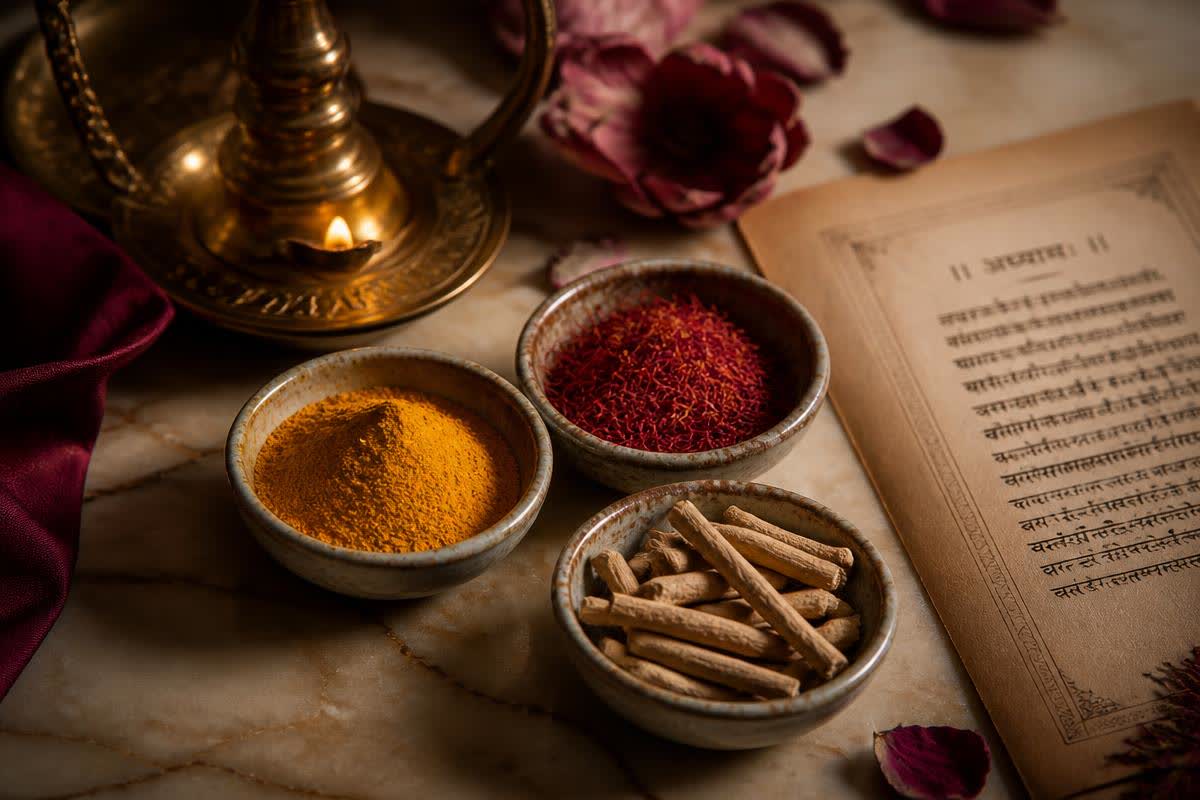
What if understanding your intimate nature began with understanding your energy? Long before modern conversations about compatibility, libido, and love languages, ancient Indian traditions were exploring the relationship between body, temperament, desire, and connection.
- Published
- 2026-08-14
- Updated
- 2026-08-14
What if understanding your intimate nature began with understanding your energy?
Long before modern conversations about compatibility, libido, and love languages, ancient Indian traditions were exploring the relationship between body, temperament, desire, and connection.
Two of those traditions—Ayurveda and the Kama Sutra—are often misunderstood in the modern West.
Ayurveda is sometimes reduced to herbs and wellness quizzes.
The Kama Sutra is frequently reduced to sexual positions.
Both are considerably richer.
Ayurveda developed as a traditional system for understanding balance within the individual, while the Kama Sutra explored pleasure, attraction, partnership, sensuality, courtship, and the art of living well.
Together, they invite an intriguing question:
What if intimacy isn't one-size-fits-all?
The Three Doshas
Ayurvedic philosophy describes three primary energetic principles known as doshas:
Vata — Air + Space
Pitta — Fire + Water
Kapha — Earth + Water
Every person is traditionally understood to contain all three, although one or two may be more prominent.
These concepts belong to Ayurveda's traditional framework and aren't biological classifications recognized by modern medicine.
But as archetypes for thinking about temperament, energy, and personal rhythms, they can offer an interesting lens for self-exploration.
Especially when we bring them into intimacy.
Vata: Curiosity, Movement & Imagination
Vata is associated with movement, air, creativity, change, and spontaneity.
A person with strong Vata qualities may be imaginative, curious, playful, and attracted to novelty.
In intimacy, this can translate into excitement around new experiences.
A different setting.
Unexpected affection.
Music.
Conversation.
Fantasy.
Playfulness.
But the same energy associated with movement can also become distraction.
When life feels overstimulating, someone embodying strong Vata qualities may find it difficult to remain present.
The mind moves faster than the body.
The Vata Intimacy Ritual
The traditional Ayurvedic response to excess movement is often grounding.
So rather than adding more stimulation, create stability.
Warm lighting.
A slower pace.
Massage.
A warm bath.
Longer touch.
Deep breathing.
Fewer distractions.
Instead of asking, How can we make tonight more exciting?, sometimes the better question is:
How can we become completely present for what is already happening?
Pitta: Passion, Intensity & Fire
Pitta is associated with heat, transformation, drive, focus, and intensity.
Someone embodying strong Pitta qualities may approach many areas of life with passion—including intimacy.
Desire can feel direct.
Attention can become focused.
Chemistry can become intense.
But fire can also become pressure.
When intimacy becomes another place to achieve, perform, or create the "perfect" experience, sensuality can lose some of its softness.
The Pitta Intimacy Ritual
For fiery energy, experiment with the opposite:
Slow down.
Remove the objective.
Let your partner lead.
Spend longer kissing.
Explore gentle touch rather than constantly increasing intensity.
Laugh.
Be playful.
Allow the encounter to unfold differently than expected.
Passion doesn't disappear when you soften it.
Sometimes softness allows you to feel the fire more clearly.
Kapha: Sensuality, Stability & Connection
Kapha is traditionally associated with earth, water, stability, nourishment, patience, and emotional depth.
Strong Kapha qualities can bring a beautiful groundedness to intimacy.
Affection.
Comfort.
Long embraces.
Emotional connection.
Slow sensuality.
A feeling of safety.
But stability can sometimes become predictability.
When intimacy follows the same pattern repeatedly, desire may need something new to awaken curiosity.
The Kapha Intimacy Ritual
Introduce movement.
Change the environment.
Put on different music.
Go somewhere together before coming home.
Try a new massage oil.
Wear something unexpected.
Dance.
Create anticipation earlier in the day.
Novelty doesn't need to mean doing something extreme.
Sometimes a small interruption in routine is enough to make a familiar person feel newly interesting.
What the Kama Sutra Was Really About
The Kama Sutra has become famous for one thing:
Sexual positions.
But that represents only part of a much larger work.
The text explores kama—pleasure, desire, sensual enjoyment, attraction, relationships, courtship, and the art of living.
It treats pleasure as something worthy of attention.
That alone offers a useful lesson.
Pleasure does not always have to be rushed.
It can be cultivated.
Through scent.
Beauty.
Music.
Conversation.
Touch.
Environment.
Anticipation.
Attention.
Intimacy becomes richer when the entire sensory world participates.
Create Intimacy Through the Senses
Try approaching an evening through each sense.
Sight.
Change the lighting.
Remove clutter.
Create an environment that makes you want to stay.
Sound.
Choose music intentionally rather than leaving television or notifications running in the background.
Scent.
Use natural aromas, incense, botanical oils, or a fragrance associated specifically with intimate time.
Touch.
Explore more than the obvious parts of the body.
Massage the scalp.
Hands.
Shoulders.
Back.
Feet.
Neck.
Let touch exist without immediately asking it to become sexual.
Taste.
Prepare something slowly.
Tea.
Fruit.
Dark chocolate.
A meal you eat without screens.
Sensuality often begins before anyone enters the bedroom.
Eye Gazing: A Simple Practice in Presence
Sit facing your partner.
Look into each other's eyes.
Don't talk for one minute.
That's it.
It sounds easy until you try it.
You may laugh.
You may feel exposed.
You may suddenly become aware of how rarely you look at someone without simultaneously speaking, thinking, or preparing your next response.
Stay with it.
Then breathe.
The purpose isn't to manufacture a mystical experience.
It is to practice being fully seen while remaining present.
Sacred Touch
Try another exercise.
For several minutes, one partner receives and the other gives.
The person receiving doesn't need to perform or reciprocate.
The person touching isn't trying to create an orgasm.
Simply explore.
Then switch.
This changes the usual rhythm of intimacy.
Instead of constantly wondering what comes next, each person gets to experience one role completely.
Giving.
Receiving.
Touching.
Feeling.
That simplicity can create surprising intimacy.
Ayurveda's Botanical Tradition
Herbs have always been an important part of Ayurvedic tradition.
Among them, shatavari has a particularly long history in approaches to feminine wellness, while botanicals such as brahmi have traditionally been used within broader practices surrounding mind and well-being.
Maca and black ginger come from different botanical traditions, but they similarly carry histories associated with vitality.
These traditions influenced the botanical philosophy behind Tantra, Akasha Herbs' women's vitality formula, which brings together shatavari, black maca, safed musli, black ginger, Cynomorium, Butea superba, brahmi, acerola cherry, black pepper, and nutmeg.
The name Tantra itself reflects the larger philosophy behind the formula:
Sexual wellness is not isolated from the rest of the self.
Body, energy, emotion, attention, and connection interact.
You Are Not a Dosha
Ayurvedic archetypes can be interesting tools for reflection.
But don't turn them into another box.
You may crave novelty one evening and grounding the next.
You may feel fiery during one season of life and exhausted during another.
You may want passionate sex today and simply want to be held tomorrow.
Human beings change.
That's the point.
Instead of asking:
"What type am I?"
Try asking:
"What energy am I bringing into this moment—and what would create balance?"
That question is much more alive.
The Art of Conscious Pleasure
Perhaps Ayurveda and the Kama Sutra share one lesson that modern intimacy desperately needs:
Pay attention.
Notice your energy.
Notice your partner.
Notice when you are rushing.
Notice when intimacy has become predictable.
Notice when your mind has left the room.
Notice what makes your body soften.
Notice what awakens curiosity.
You don't need to recreate ancient India in your bedroom.
You simply need to reclaim something our distracted world continually takes away:
Your attention.
Because pleasure deepens when attention deepens.
And intimacy becomes something entirely different when two people stop simply being beside one another—and truly arrive.
Akasha Herbs explores traditional botanical wisdom, vitality, sensual wellness, and intentional living.
This article is for educational and informational purposes only. Doshas and other Ayurvedic concepts reflect a traditional wellness system and should not be interpreted as established medical or physiological classifications. References to botanicals describe traditional uses and are not intended to diagnose, treat, cure, or prevent any disease. Consult a qualified healthcare professional before beginning any new supplement or wellness regimen.
Referenced botanicals
Continue reading
- The Alchemy of Intimacy: sacred sexuality, presence and the art of connectionA slow look at intimacy as ritual — presence, breath, touch, and the long relationship between botanicals and sensual practice.

- When Intimacy Feels Different: supporting a partner through erectile difficultyOccasional erectile difficulty is common. A calm, compassionate look at pressure, presence, and how couples can stay connected when the body responds differently.

- Semen Retention & Sexual Energy: ancient wisdom for modern menTaoist, yogic and Ayurvedic traditions treated sexual energy as something to cultivate. A grounded look at retention, transmutation, and what the practice actually asks of you.

These statements have not been evaluated by the Food and Drug Administration. This product is not intended to diagnose, treat, cure, or prevent any disease.