
Ashwagandha
Withania somnifera
A small shrub of the nightshade family whose root has been prepared in Ayurvedic practice as a grounding tonic for at least two millennia.
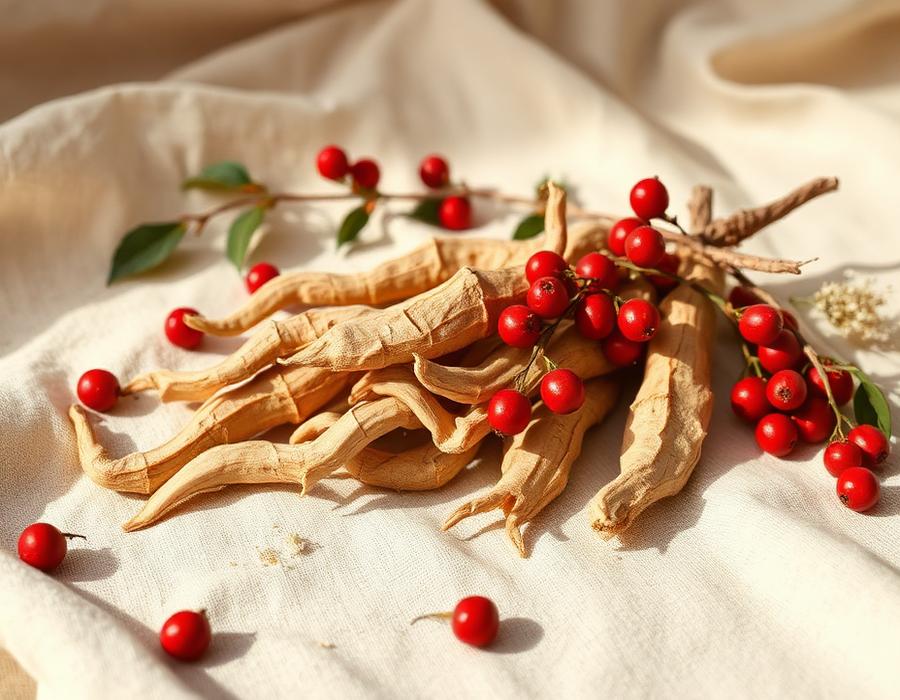
- Common name
- Ashwagandha
- Scientific name
- Withania somnifera
- Family
- Solanaceae
- Plant part
- Root
- Native region
- India, Middle East, parts of Africa
- Traditional systems
- Ayurveda
Botanical classification
A woody perennial of the Solanaceae, harvested for its pale taproot. Standardised extracts are typically characterised by withanolide content.
Origin & traditional use
Described in classical Sanskrit sources among the rasayana preparations, traditionally powdered and taken with warm milk in the evening.
Modern scientific perspective
Ashwagandha has attracted more controlled human research than most botanicals, largely on standardised root extracts, with attention to the stress response.
Evidence snapshot
Traditional record extensive. Human trials numerous by botanical standards, though sample sizes are often modest.
Proposed mechanisms
HPA-axis modulation is the most frequently proposed pathway, with withanolides the constituents of interest.
- Adaptogenic activityStudied for a non-specific influence on the body's response to everyday stressors.
- HPA axis modulationStudied in relation to the hypothalamic-pituitary-adrenal signalling cascade.
Key active constituents
- Withanolides
- Withaferin A
- Sitoindosides
Safety & considerations
Generally well tolerated. Some people prefer an evening dose.
- Contraindications
- Autoimmune and thyroid conditions warrant professional guidance.
- Drug interactions
- Consider guidance alongside sedative or thyroid medication.
- Pregnancy
- Not recommended.
- Breastfeeding
- Not recommended.
- Pregnancy and nursing. Not intended for use during pregnancy or while nursing. Speak with your healthcare provider.
- Medication interaction. If you take prescription medication, speak with your healthcare provider before use.
References
- 01 Withania somnifera and the stress response: a review of controlled trials. Various, Journal of Alternative and Complementary Medicine, 2021 — Meta-Analysis
- 02 Adaptogens: a review of the concept and its evidentiary basis. Various, Pharmaceuticals, 2018 — Systematic Review
- 03 Charaka Samhita. Attributed to Charaka, Classical Sanskrit text — Traditional Text
Related botanicals
Related journal articles
- Reading the research on adaptogens: what we know, and what we don'tThe word adaptogen carries more weight than the literature can yet support. Here is what the record actually shows.
- On repetition: how a small evening practice becomes a ritualRitual is not ceremony. It is the accumulated weight of a small act performed at the same hour.
These statements have not been evaluated by the Food and Drug Administration. This product is not intended to diagnose, treat, cure, or prevent any disease.