
Shatavari
Asparagus racemosus Willd.
A graceful climbing plant regarded as one of Ayurveda's most respected roots. Its Sanskrit name translates as "she who possesses one hundred roots", reflecting abundance and vitality.
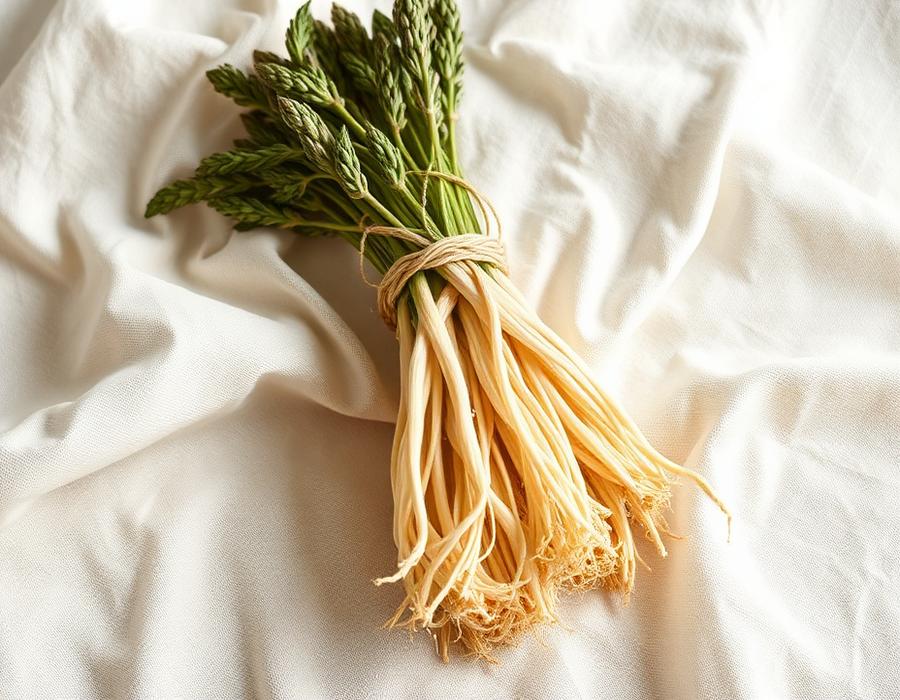
- Common name
- Shatavari
- Scientific name
- Asparagus racemosus Willd.
- Family
- Asparagaceae
- Plant part
- Root
- Native region
- India, Nepal, Sri Lanka, Himalayan foothills
- Traditional systems
- Ayurveda
Botanical classification
Family Asparagaceae · Genus Asparagus · Species Asparagus racemosus · Plant part: root · Preparation: dried root extract.
Origin & traditional use
Native to India and neighbouring regions and considered a Rasayana botanical traditionally associated with rejuvenation. Historically prepared as powders, decoctions and herbal ghees.
Modern scientific perspective
Investigates shatavarins (steroidal saponins), flavonoids, polyphenols, alkaloids and antioxidants through laboratory, animal and human studies. Why we selected it: one of Ayurveda's most celebrated botanical roots, contributing compounds that complement the broader formulation. Quality philosophy: mature roots from established Indian growing regions, tested for identity and purity. Akasha perspective: the feminine counterpart in our library, held in the same regard Ayurveda has given it for millennia.
Evidence snapshot
Traditional use: thousands of years within Ayurvedic Rasayana formulations. Preclinical research: substantial. Human research: emerging studies. Scientific consensus: one of Ayurveda's most extensively researched botanicals.
Proposed mechanisms
Shatavarins and other steroidal saponins are the constituent classes most frequently examined.
- Adaptogenic activityStudied for a non-specific influence on the body's response to everyday stressors.
- Steroidal saponin activityA class of plant compounds under investigation for endocrine-adjacent signalling.
Key active constituents
- Shatavarins (steroidal saponins)
- Flavonoids
- Polyphenols
- Alkaloids
- Mucilage
- Natural antioxidants
- Essential amino acids
- Trace minerals
Safety & considerations
Widely consumed for centuries. Discontinue use if unexpected sensitivity occurs. These statements have not been evaluated by the Food and Drug Administration. This product is not intended to diagnose, treat, cure, or prevent any disease.
- Contraindications
- Consult a healthcare professional if managing a medical condition.
- Drug interactions
- Consult a healthcare professional if taking medications.
- Pregnancy
- Consult a healthcare professional before use if pregnant.
- Breastfeeding
- Consult a healthcare professional before use if nursing.
- Pregnancy and nursing. Not intended for use during pregnancy or while nursing. Speak with your healthcare provider.
- Adults only. Formulated for adults. Keep out of reach of children.
- Medication interaction. If you take prescription medication, speak with your healthcare provider before use.
References
- 01 Asparagus racemosus: phytochemistry and traditional use. Various, Journal of Ethnopharmacology, 2018 — Systematic Review
- 02 Charaka Samhita. Attributed to Charaka, Classical Sanskrit text — Traditional Text
- 03 Asparagus racemosus monograph. Ministry of AYUSH, Government of India, Ayurvedic Pharmacopoeia of India, 2016 — Monograph
- 04 Asparagus racemosus — an update. Goyal RK et al., Indian Journal of Medical Sciences, 2003 — ReviewSource
Related journal articles
- The Alchemy of Intimacy: sacred sexuality, presence and the art of connectionA slow look at intimacy as ritual — presence, breath, touch, and the long relationship between botanicals and sensual practice.
- Understanding the G-Zone: a guide to arousal, pleasure & deeper intimacyThe G-zone is not a hidden button. It is part of a larger network of arousal, anatomy, and presence. A grounded, educational guide to exploring pleasure with curiosity instead of pressure.
- We've Stopped Having Sex: Why Desire Changes—and How to Find Your Way BackWhen intimacy fades, it doesn't mean love is gone. A grounded look at why desire changes, how to talk about it without blame, and practical ways to find your way back.
- The Female Arousal Response: What Happens When the Body AwakensFemale arousal isn't a simple switch. A grounded look at what actually happens in the body—blood flow, erectile tissue, the nervous system, and why patience matters.
- The 20-Minute Ritual: Why Slowing Down Can Transform IntimacyBetter intimacy often comes from slowing down, not doing more. A simple twenty-minute ritual for presence, anticipation, and deeper connection.
- Ayurveda, the Kama Sutra & the Three Doshas: Understanding Your Intimate EnergyWhat if understanding your intimate nature began with understanding your energy? Long before modern conversations about compatibility, libido, and love languages, ancient Indian traditions were exploring the relationship between body, temperament, desire, and connection.
- Music, Desire & Intimacy: How Sound Changes the Energy of a RoomSound shapes atmosphere before anyone touches. How music, rhythm, and ritual can shift the emotional energy of a room — and deepen intimacy.
- The Bedroom as Sacred Space: Ritual, Play & Spiritual ConnectionSacred does not have to mean serious. How ritual, touch, breath, and play can turn an ordinary bedroom into a space made for presence.
- Sexual Energy & Manifestation: The Ancient Art of Creative IntentionCan desire be directed toward intention? A ritual approach to sexual energy, creative attention, transmutation, and the ancient art of bringing what you want into action.
- The Brain Is Your Most Powerful Sexual Organ: Desire, Dopamine & the Psychology of ArousalUnderstanding why desire begins in the mind — and how attention, anticipation, novelty, and emotional connection help shape the body's experience of arousal.
- Sacred Sexuality for Couples: How to Create Deeper Emotional & Energetic ConnectionA guide to slowing down, creating shared ritual, and building deeper emotional and energetic connection through presence and attention.
- When Sex Gets Too Routine: How to Bring Back Curiosity Without the Pressure to PerformPractical exercises for couples to disrupt predictable intimacy, redistribute the responsibility for desire, and rediscover curiosity without performance pressure.
- The Art of Erotic Exploration: Trust, Curiosity & Trying Something New TogetherA gentle guide to exploring intimacy together: trust, curiosity, communication, and the freedom to say yes, maybe, or not tonight.
- Beyond the Basics: How Lubricants Can Add Comfort, Play & Pleasure to IntimacyLubricant doesn't have to solve a problem. It can simply make touch feel smoother, more comfortable, and more playful—whether you're exploring alone or with a partner.
- The Clitoris, the Vagina & the Truth About Female OrgasmFor generations, women were given a surprisingly incomplete map of their own pleasure. Modern anatomy tells a more interesting story—one that invites curiosity, communication, and presence.
- Beyond One Kind of Orgasm: Understanding the Different Ways Men & Women Experience PleasureOrgasm isn't a single event. From clitoral and G-zone to prostate and full-body experiences, explore the remarkable range of human pleasure—without turning intimacy into a performance.
These statements have not been evaluated by the Food and Drug Administration. This product is not intended to diagnose, treat, cure, or prevent any disease.